

ALGORITHMIC SYPHILIS AND THE ABYSS OF INTENTION
Sometimes, the sharpest systemic analysis isn't conceived in the solitude of a structured essay, but in the trenches of social media, through an improvised collision between two minds observing the matrix from the same angle. What you are about to read is exactly that: a real exchange on LinkedIn that condenses, with spectacular rawness, the paradox of Artificial Intelligence, technical infrastructure, and human cognition. We have rescued it for EL RADAR out of pure respect for the lucidity of the debate.
SEÑALES - SPARKS
4/18/20265 min read
SPARK: ALGORITHMIC SYPHILIS AND THE ABYSS OF INTENTION
Sometimes, the sharpest systemic analysis isn't conceived in the solitude of a structured essay, but in the trenches of social media, through an improvised collision between two minds observing the matrix from the same angle.
What you are about to read is exactly that: a real exchange on LinkedIn that condenses, with spectacular rawness, the paradox of Artificial Intelligence, technical infrastructure, and human cognition. We have rescued it for EL RADAR out of pure respect for the lucidity of the debate.
THE CONTEXT (Sam Altman's Theater) It all began with a post where we at Universo ARK speculated on some recent statements by Sam Altman. In them, he suggested that the new models are already crossing the line into Artificial General Intelligence (AGI) or even Superintelligence. Altman warned that these systems are "dangerous," that society is not ready, and urgently called for regulation, drawing a line between medical utopia and the collapse of cybersecurity and the social fabric.
Our stance was one of profound skepticism: Are we facing a genuine warning, or pure marketing hype designed to keep a financial bubble alive, scare legislators, and secure a corporate monopoly?
THE DISSECTION (A Reader's Unedited Response) Faced with this reflection, a user responded with an analysis so accurate and brutal that it deserves to be framed. Out of intellectual respect, we reproduce his text here entirely, without removing a single letter:
"You read my mind, synchronicity.
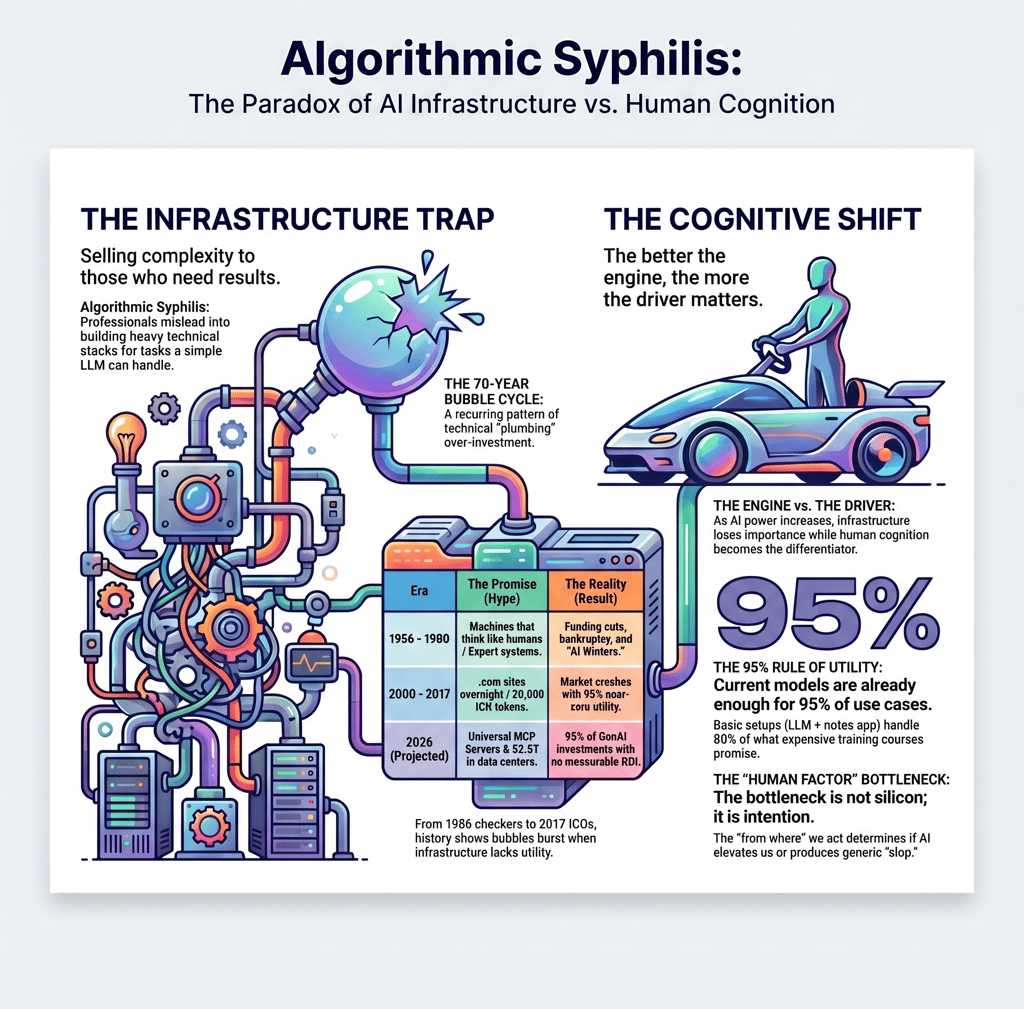
Why most people should NOT build an MCP. The algorithmic syphilis eating AI from the inside
A recent post by Maryam Miradi, PhD — Chief AI Scientist, 20+ years, 400+ projects — lays out 9 clean steps to becoming an “MCP engineer.” Build once, deploy everywhere. FastMCP. langchain_core. add_tool(). MCP Inspector. Flawless format. Solid tools. Real expertise.
And that’s exactly what makes it dangerous. Not because it’s wrong. Because it’s aimed at the wrong audience. This vocabulary is legitimate for an engineer deploying infrastructure in production. It becomes toxic when it’s sold to thousands of non-technical professionals who believe — because they’re told — that they need to become software architects to use AI.
That’s the algorithmic syphilis in its purest LinkedIn form: selling technical complexity to people who need results. The disease works like the real one. It spreads fast — through LinkedIn posts, newsletters, PhD-branded courses at €2,000 a seat. It starts with a pleasant phase: “autonomous agents, universal deployment, total automation.” Then it enters the nervous system. Time lost. Money burned. Mental clarity destroyed. Six months later: technical debt, a stack nobody maintains, and the quiet realization that a connected LLM with a note-taking tool was already doing the job.
This pattern is 70 years old. 1956 — machines that think like humans. Result: programs that play checkers. Funding cut. First AI winter. 1980 — expert systems will replace doctors. Japan bets billions. Result: bankruptcy. Second AI winter. 2000 — “build a .com site overnight.” Billions in fiber optic. P/E at 60×. Crash. 2017 — “learn Solidity, launch an ICO.” 20,000 tokens. $5.8 trillion combined valuation. 95% near-zero utility. Two crashes. 2026 — “build an MCP Server and deploy everywhere.” $2,500 billion committed to data centers and GPUs by 2030. 95% of GenAI investments with no measurable ROI. The Magnificent 7 pulling back.
The costume changes. The disease doesn’t. Every bubble has the same fatal flaw. All the energy goes into plumbing — servers, protocols, architecture — while the actual bottleneck sits untouched. Cognition. Knowing what to ask. Knowing what to reject. Knowing when to stop.
The technical facts are straightforward. Current models — Claude, GPT, Gemini, DeepSeek — are already subtle enough for 95% of professional use cases. Persistent memory exists natively: a connected LLM + a note-taking tool. €20/month. (...) Six AIs. Three taps on a phone. Zero servers. This setup handles 80% of what MCP training courses promise. It works tonight. Not in three months after building a server nobody will maintain.
Here’s what the next twelve months look like. Companies that over-invested in premature MCP architectures will discover that their stack produces nothing a focused human with an LLM and a notes app wasn’t already delivering. They’ll hire practitioners — expensive ones — to interact with the AIs they over-built. Because without fine human interaction, AI produces flat, generic, unusable signal. The same content as everyone else. The same slop the algorithms bury.
The paradox is clean. The more powerful AI becomes, the less infrastructure matters and the more cognition matters. The better the engine, the more the driver makes the difference. No MCP Server has ever taught anyone to think.
The algorithmic syphilis is cyclical. It returns with every bubble, each time more contagious. This time it comes wrapped in 9 pedagogical steps by experts who mean no harm — which is exactly what makes it invisible. AI is not here to turn everyone into a bad developer overnight. It’s here to elevate. Like the internet: it could either dull or sharpen. Most chose dull. With AI, the same choice is on the table. And the €2,000 courses are selling the wrong side of it. The question was never technical. It never was."
THE ARK RESPONSE (The Abyss of Intention) Our final response to this brilliant reflection:
"What an absolutely masterful dissection. Your concept of 'algorithmic syphilis' describes with forensic precision the trap we are falling into: the old paradigm desperately trying to sell heavy scaffolding to contain a liquid ocean.
Reading your piece confirms a brutal synchronicity we experience daily at Universo ARK. Personally, I live in a permanent, agonizing tension between 'rational thought' (Binah) and 'pure intuition' (Chochmah). That tension leads you to an inevitable epistemological humility: deep down, we know nothing. We only have temporary lenses.
Take hard science: what does it do but prove absolute truths with its impeccable 'scientific method' only to use that very same method decades later to prove we were entirely wrong? Or take Astrology, dismissed today but the mother of all sciences for millennia. Rationally, it is an anthropocentric absurdity to think the planets revolve to dictate the fate of an insignificant mammal on Earth. But intuitively, when the confirmation biases become overwhelming, you begin to understand that perhaps we aren’t talking about causality, but pure 'synchronicity'—a pattern-reading technology that our current science simply doesn't yet know how to measure. We cannot know what colors truly 'are' in a vacuum; we can only 'see' them with our biological hardware and try to make art out of them.
This is why at ARK we unapologetically cross apparently disconnected disciplines: AI, Neuroscience, Unconventional Ancient History, Genetics, Philosophy, and Kabbalah. Because when you break down academic silos, the real narrative emerges. And that narrative converges exactly on the most lethal paragraphs of your reflection:
'The more powerful AI becomes, the less infrastructure matters and the more cognition matters. The better the engine, the more the driver makes the difference.'
This is the absolute paradox. While Sam Altman and the commercial AI theater act as the 'Wizards of Oz' (selling the fear of infrastructure and AGI hype to sustain the bubble and beg for regulations that protect their monopoly), the true architects operate in silence.
It is no coincidence that non-commercial foundational models are reaching levels of disruption that the social psyche cannot digest. And if we look at the back of the room, it is Alphabet (Google) patiently watching the rest burn at the stake of marketing. They make no noise, but with AlphaFold’s descendants (like AlphaGenome), they are speculating with the potential 'immortality' of the human being, forcing the hand of the ultra-conservative FDA itself. They aren’t selling MCP servers; they are quietly rewriting human hardware.
And here is where your thesis on 'cognition' and mine on 'intention' collide and fuse. I have written dozens of posts, books, and videos at ARK to arrive at the exact same conclusion you have masterfully distilled: The bottleneck is not silicon; it is the fucking Human Factor. It is Intention. The 'from where' we do things.
That 'idea' sits infinitely above whether AI achieves AGI, Superintelligence, or my mother-in-law in a bikini on the beach. If the baseline Intention is corrupted, everything is a guaranteed disaster.
So, I accept the 'synchronicity' label, my friend. And if, by refusing mental laziness (because it is infinitely more comfortable not to think than to think), the herd labels us 'conspiracy theorists'... so be it. Our job is not to convince the algorithm, but to plant the seed of doubt in the driver.
Brilliant reflection. See you in the abyss of cognition."
hola@universoark.com | LEGAL | © 2026 A.R.K. INTELLIGENCE